Written by Justin HakutaWater boils. Machinery grinds and whirls. Dough is shredded into thin ribbons.

I am at a factory in Davao, Mindanao surrounded by piles of pancit, the ubiquitous noodle of the Philippines sold by the kilo, boiled or fried, and devoured by the ton with vegetables and a combination of shrimp, chicken, or pork topped off with a dab of fish sauce and calamansi, the Filipino version of lemon.
But this is no ordinary factory—it is an enterprise funded by the heroes of the Philippines, the balikbayans or overseas migrant workers who are single-handedly saving the Filipino economy from plummeting into disarray one foreign dollar at a time (in 2006, remittances totaled between 12-14 billion US). Two seafarer brothers, the Jandugs, have combined their savings to build this noodle factory named Best Choice, a prosperous, family-owned small business run by a third brother, an ex-teacher who manages daily operations.

Launched in 2001 with the brothers’ savings and a loan from Unlad Kayaban Migrant Services Foundation (Unlad), a social entrepreneurship-focused NGO, Best Choice produces two varieties of pancit (canton or bihon, thick or thin) as well as fruit preserves of coconut and different beans used to make the popular Filipino desert halo-halo, literally mix-mix.
Now self-sustainable, Best Choice has a full-time staff of 22 and has managed to fill a niche market supplying supermarkets and department stores with freshly made noodles and halo-halo ingredients, all while beating off the competition’s cost undercutting by providing a superior quality product and service with a smile.

But this transition from savings to concept, from start-up to self-sustainability did not happen overnight.
Migration NationThe Filipino economy is heavily dependent on remittances, or money sent home from workers abroad. It is an oversimplification to say that this alone contributes to a stagnant local economy. But a dependence on international labor markets where close to a million workers per year, including many of the country’s best and brightest, seek employment elsewhere has an undeniable impact on the local economy’s productivity and ability to generate new jobs.
I won’t go too in-depth on this topic, Filipino labor migration has been covered in a past entry (
click here); however, it is within this culture of seeking a better life through international employment that I stumble upon Best Choice, which was built from the savings of overseas Filipino workers (OFWs) and is now generating jobs and creating economic activity in a community where previously there was little.
Studies have shown that OFW savings are generally spent fulfilling the basic needs of the family: improving housing, funding educational opportunities for children, and starting or investing in small businesses such as sari-sari stores (your local bodega shop) or money lending businesses. The issue with starting businesses is that many OFWs lack the technical or financial skills required to run a successful operation.
Oftentimes the go-to business solution for returning migrants is to open a sari-sari store. This business can potentially be doomed from the start for a number of reasons including the following:
1) If you create a sari-sari store that is one of say twenty other sari-sari stores within several blocks radius, carving out your niche will be tough. Unless you have a unique product line or genius marketing skills, more than likely you will be one amongst a crowd of stores who are saturating the market with candy, cigarettes, chips, soap, and bubblegum. There is actually a Filipino term for killing a successful business through market saturation. It is called the “hot pandesal syndrome” which refers to the delicious semi-sweet buns you can buy freshly baked on almost every block in the Philippines. Essentially when one pandesal store opens and becomes popular in a neighborhood, the hordes soon follow until there are so many pandesal joints that profit amongst them becomes close to nil. The same phenomena can be observed with water purification stores, chicken breeding, or cell phone accessories—name a popular product and chances are “hot pandesal syndrome” has already struck it.
2) Beware the family, for they eye your products with hunger. It is not uncommon for family members to use the food, drinks, etc. of their sari-sari store without paying for them. While skimming from the top of the inventory may be necessary for those who would otherwise spend the day with an empty stomach, it ultimately results in the store taking a financial loss, and with the size of Filipino families, this loss could be quick and devastating.
Avoiding a variety of these common pitfalls, Best Choice represents something refreshing and unique amidst the economic landscape. It has secured deals with its clientele—as long as its product maintains its quality and reasonable price, it will retain its accounts and beat back the competitors. Because of Unlad’s business trainings and ongoing support, management is equipped with the skills to run a successful business. Complemented by a committed, happy-to-be-employed staff, who by the way receive full healthcare coverage, Best Choice has become self-sustainable and is able to provide jobs to community members with plans of expanding in the near future.

Best Choice is an example of a need being identified, in this case a lack of noodles and fruit preserves, and met with sound business skills and know-how. Best Choice is an example of money being used to not only generate profit for an individual and his/her family, but also to create jobs where previously there were none, and share the wealth. It is a glimmer of possibility for the Filipino economy that the billions of dollars pouring in from abroad can be used towards creating local employment opportunities, where perhaps one day Filipinos will be able to choose between staying in their country or moving abroad for work out of preference, not necessity.
A For Profit Non-ProfitUnlad Kayaban Migrant Services Foundation (Unlad) is a humble non-governmental organization (NGO) with grand ambitions. Tucked away in a quiet Metro Manila neighborhood next to the University of the Philippines, Unlad is one of the organizations at the forefront of social entrepreneurship in the Philippines.
Unlad originates from migrant labor roots. In 1989 its founder and current Executive Director, May-an Villalba, a former teacher, established the Asian Migrant Centre (
www.asian-migrants.org) in Hong Kong, which focused on legal assistance and crisis intervention for migrants. Invariably after each case, migrant workers would look for a new employer no matter how harrowing their experiences had been because they had no job opportunities at home and their families depended on them for income. The only option was to find a new job abroad and pray for an employer who would not abuse them.
It was this lack of opportunity and vulnerability of migrant workers that spurred Ms. Villabla to build a mechanism whereby migrants could work abroad in the near-term, but create long-term opportunities in their hometowns so that they would not have to migrate for lack of work or money. In 1996, Ms. Villalba formed Unlad Kabayan to become the dedicated vehicle to develop this concept in the Philippines.
More about Unlad Kabayan
straight from the horse’s mouth:
Our strategy is to empower local communities in the Philippines to build strong and sustainable communities through enterprise development. We are different in that we work with previously untapped sources of entrepreneurs and finances: migrants and remittances. As of 2006, nine million Filipinos reside and work overseas, earning and sending money to their families for primary needs and personal consumption. These monies are called remittances, which in 2005 totaled $10.7 billion. If mobilized, remittances can jumpstart local enterprises, creating jobs and income for local people. Unlad works with migrants to curtail extraneous spending and to save and invest in projects that will raise the socio-economic well-being of local communities.
Unlad was established in 1996 to respond to the urgent need for migrant workers to plan and organize their return to the Philippines. In 1994, it started as a special program of the Asian Migrant Center based in Hong Kong organizing savings associations [or groups of migrants that save a percentage of their earnings] as a capital build-up mechanism that would establish income-generating activities in the Philippines.
As it mobilized savings, investments and building enterprises, Unlad realized the potential for migrant savings to generate jobs and income for the unemployed and to support the livelihood of poor farmers and workers [at home in the Philippines]. Upcoming entrepreneurs and small enterprises also confront problems that usually cause their businesses to fail, such as lack of management skills, knowledge and technology. To counter these problems, Unlad [employs training sessions and ongoing project monitoring] towards [developing sustainable businesses that can] compete in a dynamic and challenging economic environment.
Since 1994, Unlad has been involved in migration at various levels, both in addressing its benefits and harnessing it as a tool for socio-economic development.
Through Unlad’s programs, products are created, jobs and incomes are generated, economic transactions in the community are stimulated, and migrant workers can come home with dignity. Since 1996, Unlad has expanded from assisting small trading enterprises such as sari-sari and supply stores to incubating larger enterprises such as food processing, free-range poultry production, and agribusiness production and processing.
Not everyone is born an entrepreneur, and Unlad goes to great lengths to reach out and educate migrants about the risks and rewards of investing. For those who chose to participate, training in savings strategies, business management, and investing is provided.
 From left to right: Best Choice's manager, assistant, and Unlad's Executive Director, May-an Villalba, reminisce about Best Choice when it first stared
The idea is to arm returning migrants with the knowledge, skills, and support required to operate a successful business so they can be part of revitalizing the local economy instead of becoming a victim of it.
Successful Unlad projects include Best Choice, a coconut husk processing plant, a biodynamic farm, a rice center, and food processing as well as virgin coconut oil processing enterprises.
Social Entrepreneurship & Human TraffickingYou may be wondering what this has to do with human trafficking (trafficking). Why, if I am conducting a study on trafficking, would I spend my time interviewing an organization that deals not with migrants who have been enslaved, abused, and exploited but instead with those who have finished their overseas contracts and are returning home looking for ways to maximize their earnings?
Trafficking is the product of a number of factors including poverty, poor education, lack of jobs, feminization of migration, organized crime syndicates, government corruption, and low awareness of trafficking at all levels of society. One of the major factors driving migration, and as a result creating a large population that is susceptible to trafficking, is the lack of local job opportunities. Many communities in the Philippines are rife with unemployment, not from lack of demand or motivation but from lack of jobs. The urban centers such as Manila in the north and Davao in the south offer some possibilities, but the demand for jobs far outweighs the supply.
While jobs can be scarce in the Philippines, particularly to those who have not attended a big name university, the global market is hungry for low-skilled, low paying jobs such as domestic and agricultural work that may be viewed as undesirable to those living in the developed world. Globalization has brought countries and economies across the world closer together. A country like the Philippines, who’s economy is based largely on exporting labor, has reacted to this increased connectivity by meeting international demand for these low-skilled jobs.
While this provides opportunities for the unemployed, it also creates a large population of migrants who are vulnerable to trafficking and exploitation at the hands of dishonest recruiters, corrupt government officials, and scheming employers. Further, the nature of jobs like domestic work, where a woman is placed into the home of a family and potentially cut off from the outside world, creates a risky environment for the maid who can be abused by the employer away from the public eye.
 Percentage of the Filipino population living below poverty line in 2003, by province. Provinces with darker shades have more people living below the poverty line. Source: Wikipedia
Trafficking is a problem that reflects a variety of issues in a culture and an economy such as a patriarchal society and widespread corruption. This is why a holistic approach to combating trafficking that includes social entrepreneurship is needed. Anything less would be incomplete.
While donations and charity are still needed to address socio-economic issues, social entrepreneurship and the services offered by Unlad are integral in stimulating the local economy and combating trafficking, potentially putting more than 10 billion dollars worth of annual remittances to productive use that could benefit individuals, communities and, if effective on a large enough scale, the country.
Transforming Waste into ProfitThree hours from Best Choice, down dirt rounds, past lines of banana and mango trees and blue-domed mosques with peeling paint, past countless posters promoting local politicians and the projects they have sponsored to drum up support for the coming election in May, past the eyes of countless vigilant cocks confidently strutting and curious half-clothed children, past military check points complete with guards armed with what looked like M-1 Garrands from the second world war, there lies a factory that has taken a formerly useless waste material and converted it into pure profit.
The material in question is coconut, the husks to be exact. Coconuts are harvested for their meat and juice, not for their hard shells, which traditionally are discarded to form heaps of what resemble brownish skulls.

Macabre imagery aside, Davao Oriental Coco Husk Social Enterprise Inc. (Davao Enterprise) is generating serious business. Processing coconut husks into fiber which is used to make anti-erosion nets (for which Unlad won an
Ashoka Changemaker Award in 2005), handicrafts, wallpaper, bed fillings and more, Davao Enterprise has found a truly productive use for an abundantly cheap resource that was previously discarded and left to rot.
Launched in 2004, Davao Enterprise was incubated by Unlad and a local development NGO, Kalumonan Development Foundation. It is an example of an enterprise that corresponds to Unlad’s vision of social entrepreneurship: economically sustainable, gender-fair, protects the environment, practices accountability and transparency, and promotes the community’s health and well-being.
 Photo by Bernice Roldan
With an onsite staff of 70, an additional 30 home-based artisans, and plans to expand, Davao Enterprise has been able to provide jobs in a community that has few other employment opportunities. Unlad was instrumental in getting Davao Enterprise off the ground and to this day continues to monitor the business and assess opportunities for growth and ways to further streamline the production process and improve efficiency.
 Photo by Bernice Roldan
With production nearing 100 tons a month, demand for processed coco fiber is showing no sign of slowing—something that has not gone unnoticed by others. Indeed several other coco-processing factories have sprung up in the past few years, including one started by a local government official, giving Davao Enterprise a run for its money; however, the migrant-supported facility has managed to keep its edge through faster production. China has been one of the main destinations for this processed fiber where it is used to fill mattresses, although a market has emerged for coco fiber handicrafts and anti-erosion nets as well.
 100% coco fiber handicrafts
 Anti-erosion nets for which Unlad won an Ashoka Changemaker Award in 2005Photo by Bernice Roldan
The processing plant is a lively place. Women laugh and gossip as they spin thread from the coco fiber. Nearby a dozen men are busy throwing coconuts onto a conveyor belt that moves slowly towards a grinder. Dust fills the air. Shirts cover mouths. Thousands of coconuts sit in patient silence, awaiting their turn. Trucks arrive sporadically with fresh shipments of husks. Processed fiber is packed into bales and stacked on top of one another like giant cubes of shredded wheat cereal.

Inside the factory store, rows of multi-colored handicrafts, from bowls to purses, fans to hats, fill the shelves, each with its unique blend of colors. The texture of the processed fiber is almost rubbery: soft and malleable to the touch yet with enough firmness to hold shape.

May-an, the Executive Director of Unlad, chats with the staff about equipment upgrades and maintenance work. There is discussion about renting an extra machine that will increase production but the plant will be essentially breaking even. This will, however, allow more people to work at the plant. “We should rent the additional machine,” says May-an. After all, this business has two forms of profit: monetary and social. The more staff are employed, the more money flows into the community: supporting families, putting food on the table, supporting education.
This is social capital.
Keeping production constant and increasing processing speed will be integral to staying competitive. There is no shortage of husks. The key is maintaining the machines so they can continue to produce ton after ton of processed fiber.

The processing plant bumps and shakes through the window of my van. The cracking and grinding of husks fade into the distance. It is time to head back. The drive home is spent discussing social entrepreneurship as a tool for social change: everything from blogs to online social networks, biodynamic farms to animal manure, apathy to activism, and dedication, delusion, and romanticism was touched on.
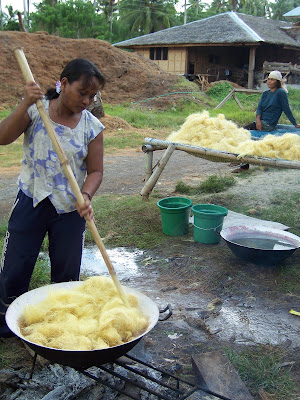 Photo by Bernice Roldan
Two Examples, One BlueprintI sit in the lounge of my business hotel (free Wi-Fi) in downtown Davao after a day of visiting two Unlad-supported businesses. Sipping a San Mig Light (the Filipino equivalent of Bud Light) and pecking away at my laptop, my head spins from the possibilities and the excitement of seeing such an idealistic concept in the flesh. In many ways social entrepreneurship is idealistic, but this does not mean unrealistic. The concept is based on finding creative ways to address social issues. One interpretation would be running a business whose profit is measured not only in net monetary gain, but also social capital. Other examples of social entrepreneurship include
reforming the school curriculum in India to reinforce the cultural identity of minority ethnic groups, working to
provide electrical energy to impoverished rural areas in Brazil, or, like Nobel Peace Prize winner Muhammad Yunus, using
microfinance as a gateway out of poverty for the poor in Bangladesh and beyond.

For Unlad, social entrepreneurship brings with it the promise of using migrant savings to revitalize the Filipino economy, inject much needed cash to poor communities, and create employment alternatives to the exodus that is labor migration.
Of course, like anything else, there are obstacles. According to the U.S. Small Business Administration, ninety five percent of small businesses in the U.S. fail within the first five years. For Filipino migrants, who return home with their savings, generally to unemployment and with few viable options beyond reapplying to work abroad, sending a son/daughter who is old enough to be a nurse, domestic worker, or seafarer to the Middle East, Europe, Asia, or the United States, or depending on a cousin or uncle who is currently abroad, the need to generate income from savings is critical to a family’s ongoing financial well-being.
Businesses like Best Choice and Davao Enterprise offer only a taste of what can be achieved with savings and support provided by organizations like Unlad, even within an economy that offers few breaks and is often completely closed to the poor.

Social entrepreneurship is not the be-all end-all of the Philippines’ local economic woes, but it is certainly a step in the right direction. While the government and large corporations are strategizing on how to best maximize labor migration and cater to international markets, organizations like Unlad are pushing the concept of social entrepreneurship and encouraging the use of migrant savings in a way that fuels jobs, benefits the local economy, and ultimately helps lift people out of poverty and the financial vulnerability that allows trafficking to prosper.
Back HomeI return to Manila with a different feeling than what I’m used to after conducting four months worth of trafficking-related interviews. Usually I talk to anti-trafficking NGOs that, after describing their generally excellent programs and revealing an inhuman perseverance, lament about the state of the justice system, the state of the government, and the need for additional funding. These are real, serious issues that often put a damper on the work of NGOs in the face of scarce resources and overworked staff. This is not to say anti-trafficking NGOs in the Philippines do not experience successes—the passing of the anti-trafficking law in 2003, the local systems that have been established to identify, rescue, rehabilitate, and reintegrate trafficking victims, and the push towards creating more aware criminal justice and law enforcement agencies—are all tangible signs of progress that can firmly be accredited to NGOs. But hearing about social entrepreneurship and seeing the possibilities in the flesh was refreshing and uplifting.
It is inspiring knowing that through self-empowerment and providing an opportunity, determined Filipino migrant workers, many of whom took the risk of being trafficked by working abroad, are able to return home and build off of their earnings in a way that can, with enough momentum, help rebuild their country and economy one noodle, one fruit preserve, one coco fiber at a time.
 Photo by Bernice Roldan
About the Author
Justin Hakuta is a U.S. Fulbright Scholar currently studying non-governmental organizations combating human trafficking in the Philippines. A graduate of Carnegie Mellon University (2004, B.S. in Decision Science), Hakuta has worked as a researcher at the Midtown Community Court in New York City helping formulate policy to reform the criminal justice system and continues to pursue his interest in human rights and social entrepreneurship by collaborating with organizations like Unlad Kabayan.
Related Links
New York Times Magazine- A Good Provider Is One Who Leaves
Carnegie Mellon University News Blog


